Automatic scent creation using generative AI
This second approach introduces a fully generative strategy in which new scents are created from scratch based only on high-level odor descriptors. A generative diffusion neural network is used to produce chemically valid mass spectra conditioned on perceptual labels such as "fresh", "woody" or "floral".
Each essential oil is represented by a 201-dimensional mass spectrum. During training, progressive Gaussian noise (up to 50%) is added to the spectra, and the network learns to denoise the signal while being conditioned on the associated odor descriptors. The evolution of the reconstruction error during training is shown in Figure 1. After training, the model achieved a mean RMSE of 0.0454 and a median correlation coefficient of R = 0.9317 when reconstructing heavily corrupted spectra.
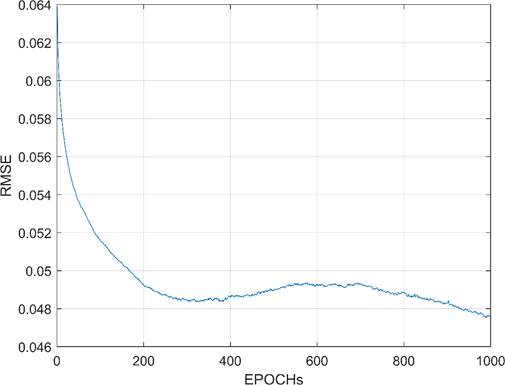
Figure 1. RMSE of the reconstruction during training. Noise is progressively increased by 0.05% per epoch, reaching 50% of the input signal by epoch 1000. The RMSE initially decreases as the network learns to reconstruct the input data, then increases due to the added noise, and finally decreases again as the network adapts and learns to denoise effectively, even at high noise levels.
During generation, the system starts from pure noise combined with a selected set of 9 odor descriptors and produces a new mass spectrum consistent with both the chemical and perceptual constraints. Principal component analysis of generated and real spectra demonstrates that the artificial scents remain within the statistical distribution of real essential oils as shown in Figure 2. Additionally, the generated spectra exhibited a median cosine distance of 0.169 to the closest real essential oil, far below random baselines.
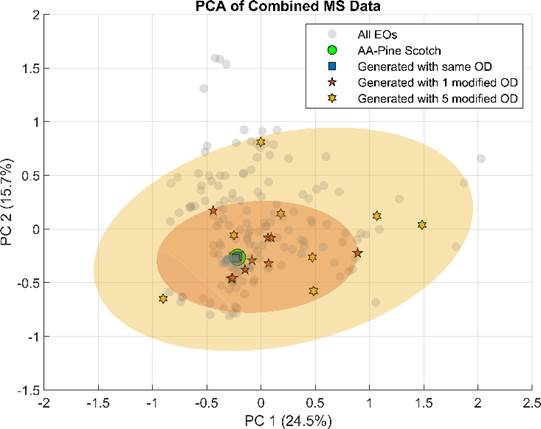
Figure 2. PCA plot of various mass spectrum data. The gray circles represent all essential oils (EO). Pine Scotch essential oil (green circle), the replication by the OGDiffusion network (blue squares), and the mass spectrum obtained when feeding one Odor Descriptor (OD) modification (orange five-point stars) or five modifications to the odor descriptors (yellow six-point stars). The shaded ellipses are Gaussian distribution estimated from the sampled points, representing the 90% cumulative area.
Perceptual validation involved three independent test protocols with 14 to 23 participants, including classification tests, 2-alternative forced-choice (2-AFC) tests, and ranking tests. Most generated scents showed statistically significant perceptual agreement with their target descriptors (p < 0.05 for the majority of odor classes), demonstrating that the diffusion model produces not only mathematically valid spectra but also perceptually correct and genuinely novel smells.
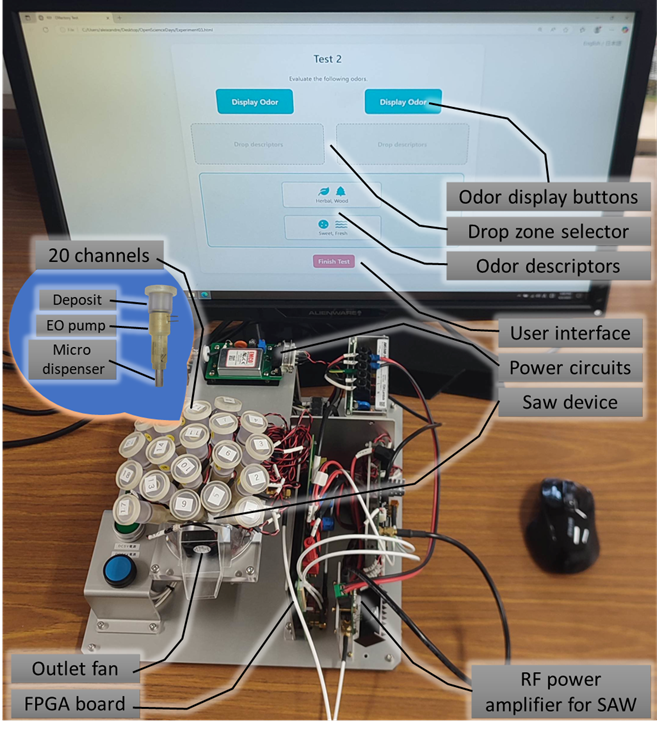
Figure 3. Olfactory display setup with the user interacting with the system. Key components are labeled. Each channel is composed by a liquid reservoir, a electroosmotic pump, and microdispenser. The computer screen shows the user interface, featuring boxes listing the odor descriptors, and drop-down menus where users select the descriptors they perceive.
Table 1. Results of the Sensory Test.
|
Correct |
Incorrect |
Odor set 1 |
Odor set 2 |
|
17 |
9 |
Wood |
Herbal |
|
Spicy |
Green |
||
|
20 |
6 |
Herbal |
Sweet |
|
Wood |
Fresh |
||
|
11 |
15 |
Fresh |
Sweet |
|
Herbal |
Green |
||
|
Floral |
Warm |
||
|
13 |
13 |
Sweet |
Fresh |
|
Warm |
Wood |
||
|
Floral |
Spicy |
||
|
19 |
7 |
Sweet |
Spicy |
|
Herbal |
Green |
||
|
Wood |
Warm |
||
|
Floral |
Balsamic |
||
|
17 |
9 |
Sweet |
Wood |
|
Fresh |
Spicy |
||
|
Herbal |
Green |
||
|
Floral |
Balsamic |
||
|
Aggregated |
|||
|
Correct |
Incorrect |
Acc. (%) |
p |
|
97 |
59 |
62.2 |
0.0015 |
References
Manuel Aleixandre, Dani Prasetyawan, Takamichi Nakamoto, Scent Creation with an Olfactory Display Based on an Odor Generative Diffusion Algorithm, IEEE SENSORS 2025, accepted.