Automatic scent creation using an optimization technique
Unlike images or sounds, smells cannot yet be easily created or edited by computers. In this work, scent design is formulated as an engineering optimization problem, in which known aromas are precisely modified by adding specific odor descriptors while preserving their original character (Figure 1).
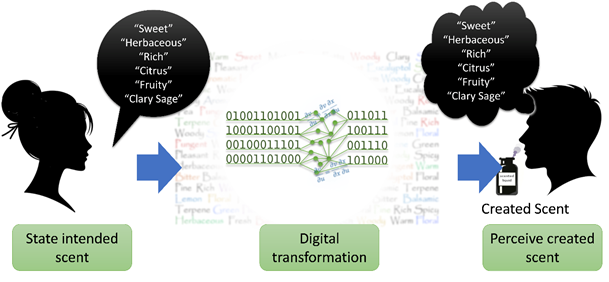
Figure 1. Scheme depicting the general procedure of the algorithm.
Natural essential oils are characterized through their mass spectra, which serve as numerical chemical fingerprints. From the spectra of 180 essential oils, 20 odor components were extracted using non-negative matrix factorization. These components act as fundamental building blocks that can be linearly combined to reconstruct complex scents. Using this representation, 94 essential oil spectra were reconstructed with a low RMSE of 0.0011. In parallel, a deep neural network (DNN) was trained to predict 39 odor descriptors directly from mass spectra, achieving an overall balanced accuracy of 0.736 (Figure 2).
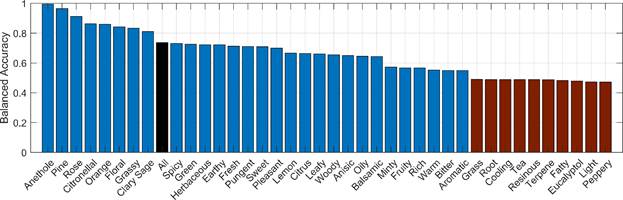
Figure 2. Balance accuracy of each odor descriptor. The blue bars correspond to odor descriptors with balance accuracy above 0.5 and red below 0.5. The "All" odor descriptor is in black.
Scent modification is achieved through a reverse gradient descent search (Figure 3). Starting from an initial uniform mixture of odor components, the predicted odor descriptors are compared to the target descriptors and the error is backpropagated to iteratively adjust only the component mixing ratios. The convergence behavior and descriptor errors of the search process are illustrated in Figure 4.
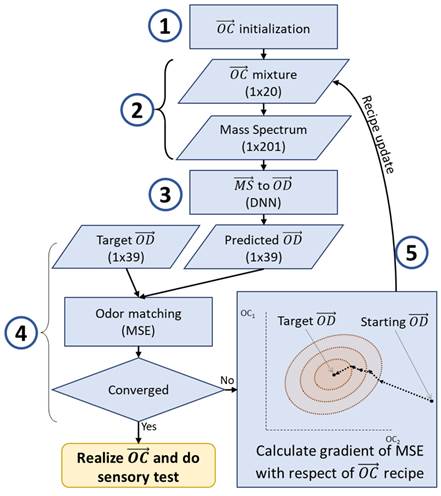
Figure
3. Scheme of the gradient descent search algorithm for odor component recipe
search.  is the vector that describe the mix
of odor components.
is the vector that describe the mix
of odor components.  is the vector that describe the odor
descriptors.
is the vector that describe the odor
descriptors.  is the vector of the Mass Spectrum
data.
is the vector of the Mass Spectrum
data.
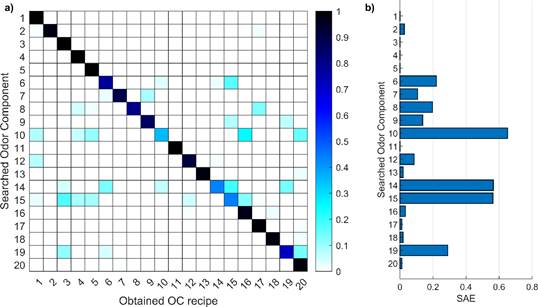
Figure 4. Errors of the optimization algorithm for the odor components. a) The odor component mix obtained b) errors on the odor components obtained.
Human validation was carried out through double-blind sensory tests with 23 participants. Subjects compared original and modified scents (same odor with one odor descriptor added) to identify the odor with the additional odor descriptor. Across 136 trials, statistically significant results were obtained (χ2 = 4.97, p = 0.026), with individual results summarized in Table 1. These findings confirm that the optimization framework can reliably impose specific perceptual odor descriptors onto existing scents.
Table 1. Sensor experiment results.
|
EO |
Added OD |
Correct |
Incorrect |
Correct |
Incorrect |
Chi-square |
p |
|
Chamomile |
Floral |
10 |
5 |
21 |
9 |
4.80 |
0.029 |
|
Citrus A.B. |
11 |
4 |
|||||
|
Cedarwood |
Sweet |
12 |
7 |
25 |
13 |
3.79 |
0.052 |
|
Origanum |
13 |
6 |
|||||
|
Cedarwood |
Fresh |
11 |
8 |
22 |
16 |
0.95 |
0.330 |
|
Origanum |
11 |
8 |
|||||
|
Chamomile |
Woody |
7 |
8 |
13 |
17 |
(0.43) |
(0.465) |
|
Citrus A.B. |
6 |
9 |
|||||
|
Aggregated |
81 |
55 |
4.971 |
0.026 |
|||
References